
It’s the beginning of a new A to Z blogging challenge and my eighth year of participating. Each day throughout April I will be posting on my theme: the history of British bridges.

Building a bridge can be a mammoth undertaking, involving engineers, a considerable workforce, and a huge supply of materials. An engineer needs to know about tension, bending, torsion and all kinds of forces. Understanding the terrain is crucial, the nature of the obstacle to be spanned, be it water, land or a chasm. And yet given these challenges, army engineers can put up a pontoon bridge across a river in one day and the Incas constructed rope bridges using grass.
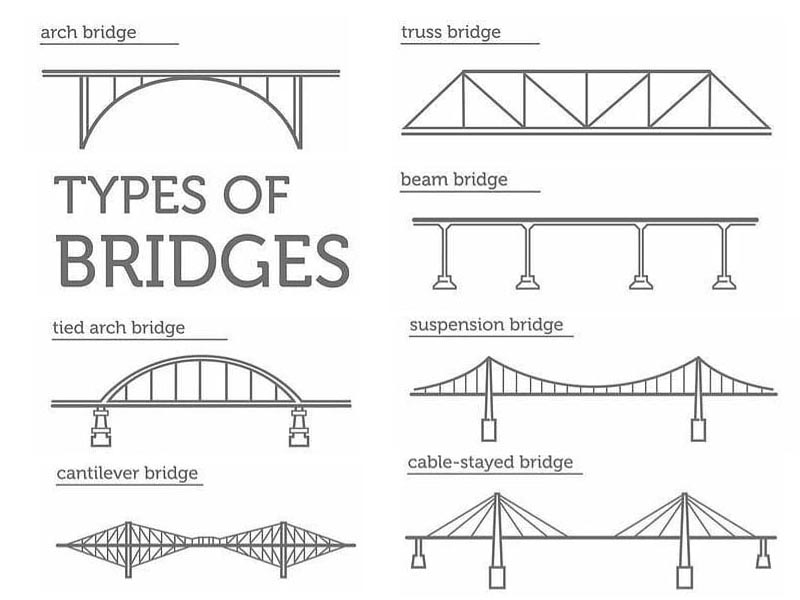
Whether it is a temporary or permanent measure, a bridge is not one simple construct, it represents a multitude of ideas for solving a common problem, and incorporates many engineering features to overcome an obstacle. Let’s start with something familiar: the arched bridge. The Romans used this basic design to construct aqueducts , and in doing so, revolutionised their road network with easy to build bridges. These structures are still there sometimes, hidden beneath other later ones.
While stone can last, and wood doesn’t, the biggest breakthrough came with the strength of iron and steel, which can support large roads and railways, then came chains and cables for suspension bridges, and modern concrete for highway bridges.
Whether its a cantilever bridge, like Tower Bridge in London, the triangles of the truss bridge, movable bailey bridges or the simple beam bridge, individual innovation is needed for each design. As for the engineers, the arrival of canals and railways, during the industrial revolution, inspired them to even greater levels of ingenuity.
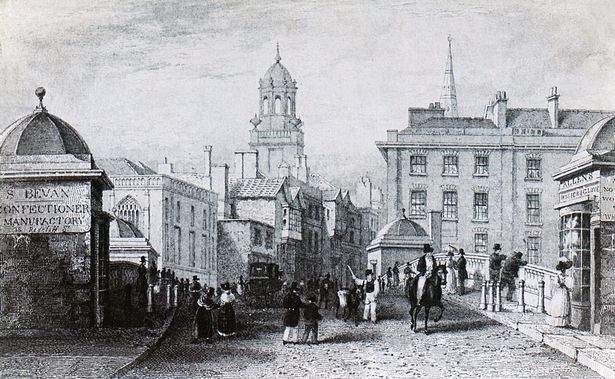
Although the location of a bridge might be a fixed point, the design of the bridge can change with time, to be rebuilt and adapted to the world around it. In Bristol, the stone bridge at the heart of the city, the Bristol Bridge, was originally built in the 13th Century on the site of a timber one. In fact Bristol’s original Saxon name Brycgstow meant ‘place of the bridge’. The bridge evolved, and by the 17th Century five storey houses were built on it. Attractive Tudor houses, with overhanging floors, and high rents given the ease of disposing of unwanted waste straight into the river (yuk!). Even so it was the posh part of the city. The goldsmiths settled on it, for what better place to trade than a bridge with constant passing traffic.

Fire destroyed some of the houses in 1647, ruining the businesses of some of the wealthiest traders. By the 18th Century the city was growing to the point the bridge, with all it’s properties was unsurprisingly too narrow. James Bridges (a surprising number of bridge builders are called Bridges) designed a bridge but for some unknown reason ran off to the West Indies before starting it. And another, Thomas Paty, (who built many of Bristol’s buildings) was chosen instead. In building this new bridge, including toll booths to pay for the cost of it, and part of the original wooden structure was uncovered before the new bridge was completed in 1768.
Tolls were not popular in Bristol and in 1793 there was a riot due to the levy on the bridge. Eleven people were killed when soldiers fired on the crowd. There were repercussions when the city corporation refused to provide funds for the deceased families. A local Quaker tried to arrange a public meeting, but the aldermen, being trustees of the bridge, refused to hold it. The citizens were united though in their anger and refused in turn to take up civic offices or duties. I suppose this is a different kind of bridge building, the community kind.
The toll booths remained to Victorian times but were used as shops. The bridge was still not wide enough, so ugly footpaths were added on either side, disguising the original Georgian design, before modern railings were added in 1960s.

As the bridge evolved and grew, so did Bristol, and another crossing was needed to span the River Avon, but not in the centre of the city, but a few miles out. The obstacle this time was the Avon Gorge.
Drop by tomorrow to find out how it was done.





 The Quiet Writer
It is a shame they had to add the ugly footpaths. At least they didn’t demolish it and start again though.
Best wishes
Tasha
Tasha’s Thinkings: YouTube – What They Don’t Tell You (and free fiction)
LikeLiked by 1 person
Ugly appendages are a pity. Thanks for stopping by.
LikeLike
This is fascinating. Thank you.
LikeLiked by 1 person
Thanks for stopping by, I hope you find the rest of my posts as interesting.
LikeLiked by 1 person
So interesting how this bridge evolved. I suppose it seemed better to throw waste directly into the river than onto the street gutter below, like I’ve heard was the custom! I plan to follow your series as much as possible.
LikeLiked by 1 person
Tudor houses occupants routinely threw their waste out of the upper windows, even on to the street below.
LikeLiked by 1 person
And sometimes passersby. Eek!
LikeLiked by 1 person
Your post made me think of something. Toll and troll sound very similar. I wonder if that story about the 3 billy goats gruff has a political origin to it?
LikeLiked by 1 person
Possibly! Worth a bit of research.
LikeLiked by 1 person
I am learning so much from this subject. Thanks for choosing this meme 🙂
LikeLiked by 1 person
Like you Alex, I am finding this very interesting and have actually passed the URL to my father who I think might follow along as well.
LikeLiked by 1 person
I hope your father finds my posts interesting. Plenty still to come.
LikeLike
I’m enjoying the research. There’s more to it than even I anticipated!
LikeLike
I do enjoy looking at bridges when we pass… and sometimes not even wanting to go over them. I’d so love to see the Golden Gate bridge in person. Very interesting post.
LikeLiked by 1 person
I’ve had the opportunity to both see the Golden Gate and drive over it.
LikeLiked by 1 person
Oh awesome. My husband also went over in the bus in catching his plane for Thailand
LikeLiked by 1 person
Learning about things is always a good thing for me.
LikeLiked by 1 person
I hope I can find so more interesting facts for you.
LikeLike
Lovely theme! I am learning a lot from it. I kinda still like the idea of living in a house on a bridge, even though it probably wasn’t as charming as it sounds…
The Multicolored Diary
LikeLiked by 1 person
The building of houses on bridges was very common in cities. More to follow on this.
LikeLike
Wow! fascinating post!
LikeLiked by 1 person
Thanks for all the bridge terms. That’s bound to help as I read the rest of these posts. I grew up in a small Mississippi River town with a truss bridge — the only bridge between St. Louis and Hannibal, a very long stretch of water. It was so narrow that driving over it was a rite of passage for teenagers. It’s recently been replaced by a modern concrete highway bridge — much safer and less prone to flooding, but I miss the old bridge in the landscape.
LikeLiked by 1 person
Goodness, I’d no idea that Bristol had once had its own version of Florence’s Ponte Vecchio. Fascinating stuff.
Debs visiting this year from
Making Yourself Relationship Ready
LikeLiked by 1 person