

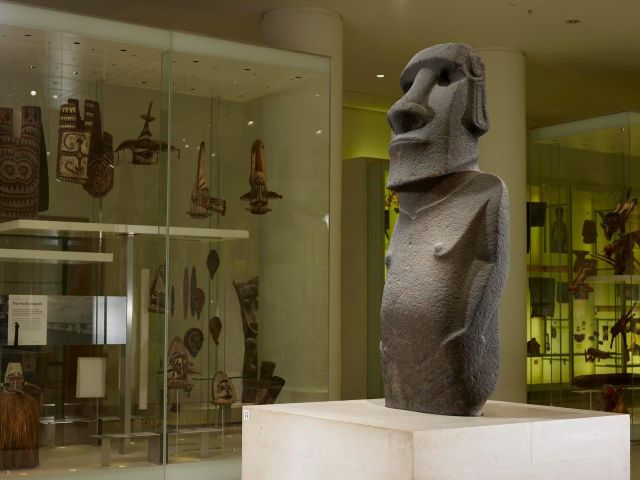
The mother of museums, but not the oldest, founded in 1753 during period of Enlightenment. World famous, controversial, imperial, and a tourist magnetic. Famed for its library and antiquities, the legacy of the vast sprawl of the British Empire. The objects in the British Museum embody knowledge from which both public and scholars might learn, and perhaps the origins of curatorship in the modern sense.
The collection began with naturalist Sir Hans Sloane bringing back the Natural History of the West Indies in the form of ‘rarities’, 80,000 of them, plus 40,000 books and manuscripts, 20,000 coins and medals. George II gave Royal Assent to the Act of Parliament in 1753 for the founding of the museum in order to promote order and tolerance following the panic instigated by the Jacobean rebellion. So this isn’t a museum founded on a royal collection or the church; it was open to the public from the outset. The world’s first “free” museum. Tickets were still needed as entry was restricted, and consequently the museum was only available to the well-connected. From 1830s onwards it was truly free and accessible. Over 260 years, 8 million objects have been collected.
Some notables include in 1802 – following the defeat of Napoleon in Egypt – the Rosetta stone, plus mummies, and in 1816, the Greek Elgin marbles.
The original building, the old Montagu House, was demolished in 1823 and work began on Robert Smike’s Greek revival building to house the King’s Library, on the ground floor, and continued on as the largest building site in Euruope, including the Round Reading Room (1857) with its iconic dome. The last major rejuvenation happened with the Queen Elizabeth Great court opening in 2000.
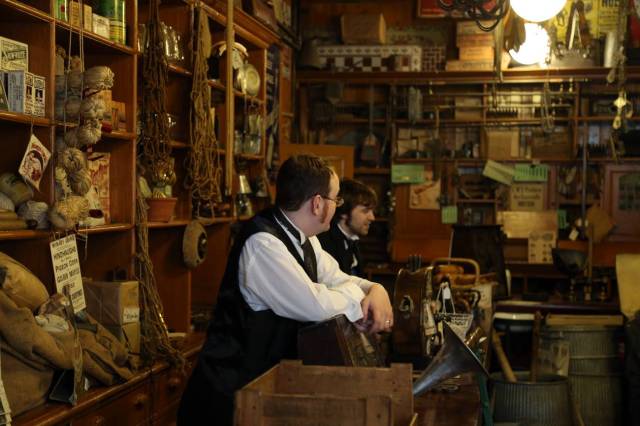
The British museum exemplifies the traditional. A building housing artefacts and objects, thereby explaining their origins and history, and value is given based on the finds themselves. But what of the opposite, where the everyday objects are returned to their original state and used? The living museum using restored objects?
Beamish open-air museum in northern England is one example of this type of restoration. Opened in 1972, it is an educational resource, like any other museum, but it entertains above all else. Inspired by Scandinavian folk museums, Beamish keeps alive the traditional industries of the industrial revolution. Covering 350 acres you can walk the streets of a town, visit stores, a pub and furnished houses, there’s a sweet shop and bank, railway station and tramway, a fairground, colliery and school. The collections are presented in situ, with interpreters. It’s a fun place to take the family, especially on a fine day.
So which is best? – a museum of objects in cabinets or a living museum? Both educate, but perhaps the former is dry and uninspiring, while the latter can only house artefacts that can bear the elements and constant changes environment. Both surely, as it depends on the fragility and age of the objects, and there is value in rarity if an object is the only one of its kind – hands off kids! So lets celebrate both.
Which would you prefer to visit?







 The Quiet Writer
I wouldn’t be able to choose between the cabinet and the living museum. I appreciate both, the cabinet gives great focus on objects, often with a lot of information to read (if you want). The living museum helps your imagination going, what was it like, what did it sound like, how did people enter those low doorways, what would this place be like throughout the seasons, etc?
Great theme for the challenge, I look forward to reading more!
LikeLike
I don’t think I could choose either. Taking kids to a living museum is easier on them, though, so we’re more inclined to visit them these days.
LikeLiked by 1 person
They are so different from one another that I don’t how I’d choose. But I guess that as I’ve visited the British Museum many-a-time but never the Beamish, it has to be the latter!
Here’s my B!
LikeLike
Beamish is great fun, and there are others like it, although I think Beamish is the largest.
LikeLiked by 1 person
I visited the British Museum in 1998. It is terrific. I remember being shocked and appalled that people were touching the Rosetta Stone!
I wasn’t able to visit the Beamish but I’d really love to as I’m fond of open-air museums and think the industrial revolution/labor history is a great subject for people to learn about.
LikeLike
I’ll be covering more on industrial museums in future posts, so watch out.
LikeLiked by 1 person
I agree, both are precious. And we are lucky to be able to enjoy both kinds 🙂
@JazzFeathers
The Old Shelter – The Great War
LikeLike
A bit of both is best!
LikeLike
I like both kinds. 8 million objects is a lot!
LikeLike
In most national museums only a small percentage of objects are on display, the rest are in storage.
LikeLiked by 1 person
It’s like that in our museums also and how big the bldg is determines how much can be out. Also means you have to constantly see what is being exhibited at any one time to see what you want to see 😦 Wouldn’t it be nice to have a holodeck that contains them all 🙂
LikeLike
Many years ago I went to the British Museum. I think I was probably mostly interested in the Egyptian stuff at the time. I would much prefer the Beamish Museum and am interested to hear about it. We had something similar in Sydney many years ago. Old Sydney Town. Fantastic stuff for a school excursion. https://en.wikipedia.org/wiki/Old_Sydney_Town
LikeLike
I don’t think the British Museum is at all dry and uninspiring!
LikeLike
[…] did the Natural History Museum begin its own life?It actually started out as the British Museum, the one in Montagu House, with Hans Sloane collection, which was purchased by the British […]
LikeLike